
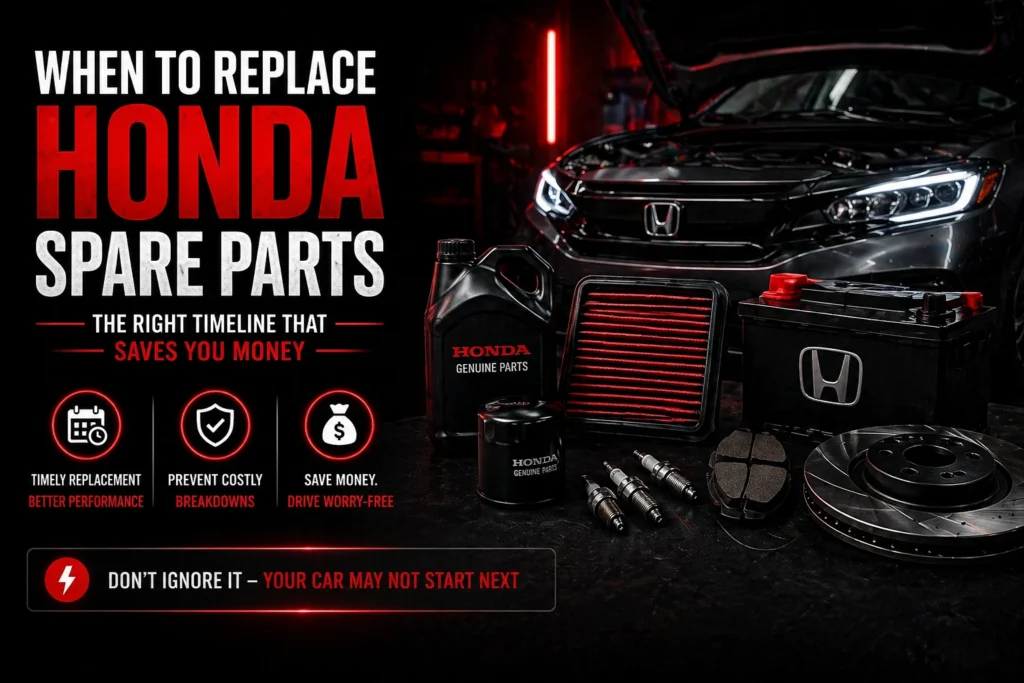
The timing of replacing Honda spare parts is what actually keeps your Honda running reliably for a long time. Most owners do not fail because the car is unreliable. They fail because they replace parts late or follow generic timelines that do not match real conditions. This guide gives you a timeline to manage Honda spare parts without wasting money or risking breakdowns.
Why Timing Matters for Honda Spare Parts
Honda vehicles are made to last. They still need maintenance. Every part of the car has a wear cycle. In places like Doha that cycle gets shorter because of the heat, dust and traffic. When you delay replacement the cars performance drops first then its efficiency and finally its reliability.
Most breakdowns do not happen suddenly. They build up slowly through ignored warning signs. Delayed servicing. If you follow the manual-based intervals without adjusting for real driving conditions you either pay too much or do not maintain the car enough. The right approach is balancing the mileage, environment and early symptoms of your Honda parts.
Honda Spare Parts Replacement Timeline Guide
A structured replacement plan helps you avoid guesswork and unnecessary expenses. Below is a timeline based on actual usage patterns:
- Engine oil and oil filter typically need replacement every 5,000 to 10,000 km to keep the engine healthy.
- Air and cabin filters should be replaced every 10,000 to 15,000 km in dusty conditions like Doha.
- Brake pads generally last between 30,000 to 50,000 km depending on your driving style and traffic conditions.
- Car batteries in climates usually last around 2 to 3 years before their performance drops noticeably.
- Spark plugs and timing components vary more. Should be inspected regularly after 40,000 km.
These numbers are not fixed rules. If your driving involves traffic, frequent short trips or aggressive acceleration Honda spare parts will wear faster than expected.
Critical Car Warning Signs You Should Not Ignore
The mileage of your Honda gives an idea but your car always tells you more through behavior changes. Ignoring these signs is where repair costs start increasing. A slight delay in response unusual noise or reduced efficiency is often the sign that a Honda spare part is wearing out.
For example reduced acceleration can point to air intake or ignition issues with your Honda parts. Weak AC airflow usually signals a cabin filter. Brake noise or vibration indicates pads while slow engine cranking suggests a weakening battery. These are not issues. They are early-stage warnings.
Many engine-related issues also begin with startup irregularities, where early inspection can prevent major failures later. Acting at this stage keeps costs controlled and avoids breakdowns of your Honda parts.
Honda Spare Parts That Wear Faster in Doha
Doha’s climate directly impacts how quickly Honda spare parts degrade. High temperatures reduce battery efficiency while dust accumulation blocks filters faster than usual. Rubber components like belts and hoses also deteriorate quickly due to continuous heat exposure.
If you follow service schedules without adjusting for local conditions you are already delaying replacements of your Honda spare parts. This is one of the common reasons vehicles face unexpected issues despite regular servicing.
Honda Spare Parts Cost vs Timing Strategy
Most owners try to save money by delaying replacements of Honda spare parts. That approach usually backfires. A low-cost part, when ignored often damages components leading to higher repair costs.
For instance a neglected air filter affects combustion efficiency increasing engine strain on your Honda parts. Worn brake pads can damage discs, doubling repair expenses. A weak battery can fail suddenly causing inconvenience and additional service costs.
The smarter strategy is simple. Replace Honda parts early when signs appear not after failure. That’s how you control long-term expenses.
Honda Spare Parts Quality Selection
Choosing the Honda spare parts matters as much as timing. Not all spare parts deliver the performance or durability. Genuine OEM parts offer the compatibility and lifespan while OEM-equivalent options provide a balanced cost-performance ratio.
Cheap aftermarket parts may look like a saving initially. They fail faster and often create repeat issues. For systems like brakes, engine components and electrical parts of your Honda spare parts quality should never be compromised.
Practical Maintenance Approach That Works
Instead of reacting to failures, a proactive approach keeps your vehicle stable. Regular inspections, timely replacements, and consistent servicing create predictable performance and reduce unexpected costs.
Focus on maintaining essential systems before they show major symptoms. Small, consistent actions prevent larger mechanical failures and extend the overall life of your vehicle.
Real-World Scenario
A Honda owner experienced a delay in engine start. Since the issue disappeared quickly it was ignored. Within a weeks the battery failed completely affecting the starting system and increasing repair costs.
This is how most problems escalate. Early signs are ignored because they seem small. By the time action is taken multiple components are affected.
When You Should Take Immediate Action
Some situations require attention and should never be delayed. If your Honda shows noise, reduced performance, warning lights or braking inconsistency it indicates deeper mechanical issues with your Honda spare parts.
Ignoring these signs increases both risk and repair cost. Early diagnosis is always faster and cheaper than -failure repair.
Conclusion
Managing Honda spare parts is not about following a fixed schedule. It’s about understanding how your vehicle behaves under real conditions and acting at the right time.
If you combine mileage tracking, symptom awareness, and climate-based adjustments, you avoid unnecessary costs and keep your Honda performing as it should. At AMTTS, the focus stays on accurate diagnosis, quality parts, and long-term reliability, not temporary fixes.
FAQs
1. How often should Honda spare parts be replaced?
Replacement depends on usage. Most components fall within a 5,000 to 100,000 km range based on type and conditions.
2. Do Honda parts wear faster in hot climates?
Yes. Heat and dust significantly reduce the lifespan of batteries, filters and rubber components of your Honda parts.
3. Is it okay to delay small replacements?
No. Small delays often lead to mechanical failures and higher costs for your Honda spare parts.
4. Are genuine parts necessary?
For critical components, genuine or high-quality OEM parts are strongly recommended for reliability of your Honda spare parts.
5. Where should I get my Honda checked?
A professional service provider like AMTTS ensures inspection, accurate diagnosis and reliable spare parts replacement, for your Honda spare parts.