
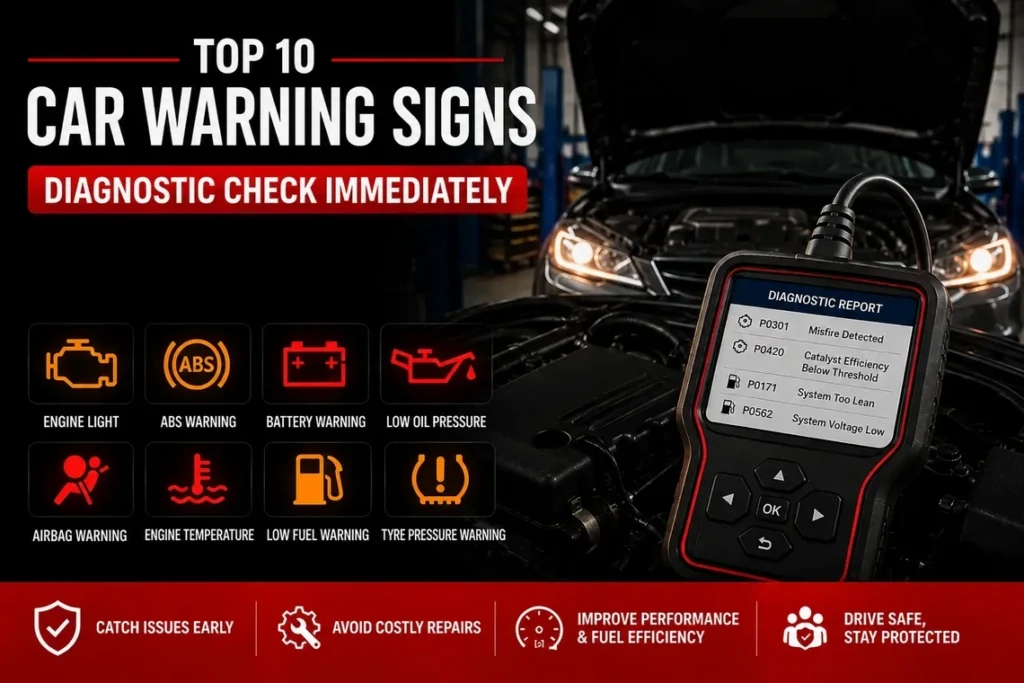
Even though cars today are smarter than ever, you need to tell them when something doesn’t feel right. A lot of drivers don’t pay attention to common car warning signs because the car “still seems fine” or because they’re afraid that taking it to the shop will mean an expensive repair bill. In fact, if you ignore small problems for too long, they often grow into big ones.
A quick car diagnostic test can identify hidden problems before they turn into breakdowns, engine damage, unsafe driving conditions, or costly repairs. Paying attention to early car Warning Signs can save you time, stress, and money, whether you drive to work every day in heavy traffic, cross Qatar on long trips, or just run errands with your family.
Professional mechanics at AMTTS use cutting-edge testing tools and original parts to keep cars safe, dependable, and running well in Qatar’s tough driving conditions. If any of these things happen to your car, you should get it checked out by a professional as soon as possible.
Why Car Diagnostics Matter More Than You Think
A modern vehicle contains dozens of sensors and onboard computer systems that constantly monitor your engine, brakes, transmission, battery, emissions system, and other critical components. A professional car diagnostic test connects directly to those systems to detect faults, performance issues, and hidden problems that may not yet be obvious while driving.
Ignoring early car warning signs can lead to:
- Higher repair costs later
- Reduced fuel efficiency
- Sudden breakdowns
- Safety risks for you and your passengers
- Damage to expensive components like the engine or transmission
Professional diagnostics are especially important for drivers looking for dependable car service in Qatar because high temperatures, stop-and-go traffic, and long commutes place extra stress on vehicles year-round.
There are many sensors and computer systems inside modern cars that keep an eye on the engine, brakes, transmission, battery, pollution system, and other important parts all the time. Expert car diagnostic tests link directly to these systems to find faults, performance issues, and hidden issues that might not be obvious while driving.
Professional diagnostics are especially important for drivers looking for dependable car service in Qatar because high temperatures, stop-and-go traffic, and long commutes place extra stress on vehicles year-round.
Early diagnosis has many benefits, such as:
- Finding problems early on so they don’t need major fixes
- Getting better gas mileage and performance
- Getting more use out of your car
- Staying away from roadside breakdowns
- Making driving safer overall
The 10 Warning Signs You Should Never Ignore
| Warning Sign | What It Might Mean | How Urgent It Is |
| Check engine light | Issue with the engine, pollution, or sensors | Moderate to high |
| Lights for ABS or brakes | Problem with the brakes | High |
| Poor fuel economy | Not working well or a problem with a sensor | Moderate |
| Strange noises | Tires, brakes, or the engine wear out | Moderate to high |
| Rough idling or stalling | Problem with the spark or fuel supply | High |
| Having vibrations or pulling | Problems with the tires, alignment, brakes, or springs | Moderate |
| Burning smells or fuel odor | Having a leak or too much heat | High |
| Sluggish acceleration | Problems with the transmission or engine | Moderate to high |
| Smoke or steam | Too much heat or a fluid leak | Critical |
| Hard shifting transmission | Fault in the transmission or low fluid | High |
1. Check engine light
The check engine light is one of the most common car warning signs, but many people drive with it on for weeks or even months before getting it checked. It could be something small, like a loose fuel cap, or it could be a sign of a major problem with the engine, ignition, emissions, or fuel system.
In the background, one of your car’s sensors has sent a problem code to the computer. There is no accurate way to know if the problem is small or could be harmful without proper diagnostics.
Ignoring the warning can make the car use more gas, put out more pollution, and damage expensive parts like the catalytic converter over time.
If the light stays on and the car feels fine, you can generally drive for a short time while making an appointment for a diagnostic soon. But if the light flashes, you should pull over as soon as it’s safe to do so.
2. Lights for ABS or brakes (ABS, Airbag, Battery, Oil, etc.)
The warning lights on your dashboard are your car’s way of saying, “Pay attention!” Whether it’s the ABS light, the battery light, the oil pressure warning, or the airbag indicator, these systems are all linked to safety and the dependability of the car.
A lot of drivers think these lights are just sensor problems, but ignoring them can put their safety at real risk.
If the battery or oil warning light comes on while you’re moving, you should get it checked out right away. If you keep driving with low oil pressure, the engine will get badly damaged in just a few minutes.
Modern cars depend a lot on computerized safety systems, so any car service center in Qatar should always include proper electronic testing.
3. Decreased Fuel Efficiency or More Frequent Fuel Stops
If your gas tank suddenly runs out of gas faster than normal, there may be a problem with your car that needs to be looked into.
Many drivers say it’s because of traffic or bad gas, but a drop in mileage usually means there is a problem with the car’s electronics or mechanics that needs to be fixed.
You will keep spending more money on gas if you ignore the problem, and the problem will get worse. In some cases, problems with the fuel system that aren’t fixed can damage engine parts over time.
If your car still drives regularly, you can usually keep driving for a short time while you set up a diagnostic check. But if the car is using more gas and running rough, stalling, or flashing warning lights, it should be checked out sooner.
Professional car maintenance in Qatar is especially important because heat and heavy traffic can place extra strain on cooling and fuel systems.
4. Unusual Noises From the Engine, Brakes, or Under the Car
Things that cars do rarely just sound weird. Sounds like grinding, knocking, squealing, clicking, or shaking are often early signs of wear or mechanical failure.
The risk depends on where the noise is coming from, but ignoring it generally means having to pay more to fix it later.
Noise from the brakes is a regular problem. What starts out as a cheap repair of brake pads can become expensive damage to the rotors if it is not fixed right away.
If the sound isn’t too loud and the car drives properly, get it checked out right away. If the noise gets loud or fast, or if it affects your ability to steer or brake, you should stop driving right away and get it checked out.
5. Rough Idling, Stalling, or Hard Starts
If your car shakes while it’s idling, is hard to start, or stops running for no reason, there is probably a problem with the battery, fuel supply, ignition, or airflow.
Spark plugs that are wearing out, problems with the fuel injectors, sensor faults, or problems with the battery or starting are common causes of these symptoms.
Ignoring rough idling or stalling can lead to dangerous situations, especially when moving in traffic or on the highway. It could also cause total breakdowns if the problem gets worse.
At first, a hard start may not seem like a big deal, but many battery and alternator problems happen slowly before they leave drivers stuck.
If the car sometimes has trouble starting but drives properly afterward, you should get it checked out soon. If the car frequently stalls or won’t start again, you should get a professional to look at it right away.
6. Vibrations, Shaking, or Pulling While Driving
At standard speeds, a car that drives smoothly shouldn’t shake, pull to one side, or vibrate too much.
These signs and symptoms could mean:
- Problems with wheel balance
- Tires not balanced
- Wear on the springs
- Not working brake rotors
- Faults in the steering system
Some sounds only happen when you slow down, while others happen at highway speeds or when you speed up.
Ignoring these car warning signs affects both safety and comfort. Over time, uneven tire wear, bad brakes, and losing control of the car can become big problems.
For instance, a small problem with wheel balance can damage tires too soon, which means they need to be replaced more often and for a lot more money.
If the vibrations aren’t too bad, you can usually drive slowly for short distances while setting up the check. If it gets hard to turn or the shaking gets worse, don’t drive the car until it’s been checked out.
7. Burning, Fuel, or Sweet Chemical Smells
Strange smells are one of the easiest warning signs to spot, but a lot of drivers don’t pay attention to them until the problem gets worse.
A smell of fuel could mean that there are dangerous fuel leaks, while a smell of sweets is often a sign of cooling leaks that could lead to the engine getting too hot.
Set up a check soon if the smell is mild and only lasts for a short time. Stop driving right away if the smell gets strong, stays with you, or is followed by smoke.
8. Loss of Power, Sluggish Acceleration, or Hesitation
There may be problems with the engine, transmission, airflow, or fuel delivery systems if your car feels weak, slow to react, or hard to speed up all of a sudden.
Filters that are clogged, sensors that aren’t working right, transmission problems, turbocharger problems, or problems with the ignition system are all possible reasons.
Ignoring slow performance can make the car use more gas and put extra stress on important engine parts.
The problem should be diagnosed soon if it is mild and stays the same. If the car quickly loses power while you’re driving or has trouble staying at a safe speed, you need to check it out right away.
9. Smoke, Steam, or Unusual Exhaust Colour
One of the clearest signs that your car needs instant attention is smoke or steam that you can see.
You should never ignore even small amounts of smoke because the problem can get worse very quickly.
Especially when moving, overheating can quickly destroy an engine if it keeps going.
10. Transmission Jerks, Hard Shifts, or Delayed Engagement
Transmission problems usually start slowly before they get bad enough to need expensive fixes.
There may not be enough transmission oil, problems with the sensors, internal wear, or electronic transmission faults if these signs show up.
It’s risky to ignore early signs of a transmission problem because gearbox repairs are some of the most expensive car repairs. When small repairs are done early on, they can often keep big parts from breaking down later.
If shifting feels a little rough, but the car can still be driven, you should get tests done right away. If the gears don’t engage properly or the car becomes hard to handle, you should stop driving and have a professional look at it.
Why a Professional Diagnostic Check Beats Guesswork
A lot of drivers buy cheap code readers or look up signs online in the hopes that they can figure out what’s wrong on their own. Basic code readers can show trouble codes, but they don’t always give a full picture of the problem.
For instance, a fault code might say that there is a problem with the oxygen sensor, but the real issue could be with the fuel supply, vacuum leaks, or the ignition.
It’s important to know this because it costs time and money to replace the wrong part.
Diagnoses at AMTTS are meant to find the reason, not just hide the symptoms for a while. This, along with original parts and skilled techs, helps make sure that repairs are done right the first time.
Professional diagnostics give drivers peace of mind and long-term savings when they need reliable car repair in Doha, reliable car service in Qatar, or help with preventative maintenance.
Conclusion
Your car usually gives warning signs before a serious breakdown happens. The key is recognizing those signs early and taking action before the problem becomes more expensive, inconvenient, or unsafe.
Whether it is a dashboard warning light, unusual smell, rough shifting, or sudden loss of power, a professional car diagnostic test can quickly identify what your vehicle needs.
At AMTTS, experienced technicians provide trusted diagnostics, quality repairs, and genuine spare parts designed to keep your vehicle reliable in Qatar’s demanding driving conditions.
If you recognize any of these car warning signs, do not wait for the problem to get worse. Contact AMTTS today to schedule a diagnostic check and keep your car running safely and efficiently.
FAQs About Car Diagnostic Checks
- How long does a car diagnostic check take?
Most standard diagnostic checks take between 30 minutes and one hour, depending on the issue and the complexity of the vehicle.
- Is it safe to keep driving if my check engine light is on?
If the light is steady and the car feels normal, short-term driving is usually possible while arranging service soon.
- How often should I get a diagnostic scan done?
It is smart to schedule a diagnostic scan during routine maintenance visits or whenever your vehicle behaves differently than normal.
- Do diagnostics always mean expensive repairs?
No. Many diagnostic inspections uncover relatively minor issues such as sensor faults, loose connections, or maintenance-related problems. Catching issues early is usually far less expensive than waiting until major damage occurs.